
200 free spins no deposit in the UK: what the offer actually costs and where it stands in 2026
A 200 free spins no deposit bonus in the UK looks like free money on the surface, and it is closer to a contract than a gift underneath. The spins are real. Anything left after the wagering conditions are cleared is yours to withdraw, with a ceiling. The contract reads in terms of game cycles and turnover caps, and the rules around it are not the casino’s — they are the Gambling Commission’s.
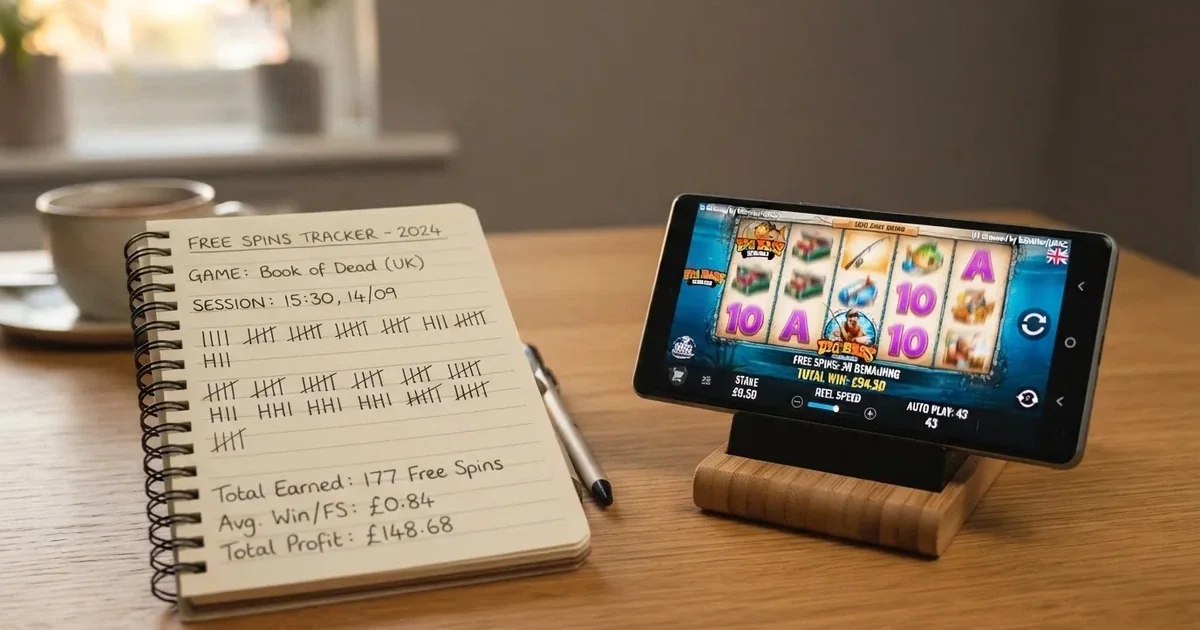
This page reads those terms in plain English. It lays out who can legally offer such a promotion to UK players, what the £10x wagering cap since 19 December 2025 means for any offer that touches real cash, what GAMSTOP does to a no-deposit spins credit, and how ten Gambling Commission licensees compare on the facts the public register actually publishes. The angle is cost: what the offer takes out of the reader’s pocket, what it cannot promise, and where the marketing language stops and the rule begins.
Data current as of 28 September 2026, verified against the Gambling Commission’s public register of gambling businesses.
Table of Contents
- The legal frame a 200-spins offer has to fit inside
- Safer-gambling tools that reach the bonus
- Getting winnings out: the payment side
- Wagering, max win, and the offer behind the spin
- The turnover band, in plain arithmetic
- The licensed landscape in 2026
- Paddy Power: high-street licence, separate casino arm
- Betway: casino-focused under one licence
- Virgin Games: the white-label route
- PokerStars: the poker name’s casino arm
- William Hill: legacy brand, broad catalogue
- 888casino: casino-only under one name
- Unibet: live-dealing heritage
- Midnite: the new-entrant shape
- Ladbrokes: shared licensee with Coral and Gala Bingo
- BetVictor: family-named brand
- Offshore: the route that closes the player out
- Tax and what stays with the player
- What the operator’s small print actually costs
- What this page does not do
- Frequently asked questions
The legal frame a 200-spins offer has to fit inside
The legal frame is the Gambling Act 2005, administered by the Gambling Commission for Great Britain. Since the Gambling (Licensing and Advertising) Act 2014, any operator taking customers in Great Britain needs a Commission licence wherever it sits in the world — a Curaçao or Malta licence alone does not authorise play from a UK address. Online casino is a licensable activity, and the test of whether a brand is allowed to advertise any bonus at all in this market is the Commission’s public register.

On 18 September 2026 that register listed 139 businesses holding an active remote casino operating licence, and the domain list it sits beside held 1065 active and 361 white-label domain entries. A white-label domain trades under another company’s licence — so a site whose name does not appear in the licensee column may still be legal, and the register is the only way to know which. The licence number itself follows a fixed shape: six digits for the account, an R for remote, a further sequence and a suffix. Reading the number is a quick way to confirm the licence is online, not a retail betting shop.
The stakes in a slot spin are not the casino’s choice. Since 21 May 2025 every online slot has carried a maximum stake per game cycle of £5 for players aged 25 and over, and £2 for 18 to 24-year-olds. Since 31 October 2021 auto-play has been banned, and no spin may resolve faster than 2.5 seconds — losses dressed up as wins are also banned. Credit cards have been off the table since 14 April 2020, including when the credit card sits behind an e-wallet. The Commission estimated around 800,000 people used credit cards to gamble in 2018; 22% of online gamblers who did were classed as problem gamblers. That is why the rule exists, and why no no-deposit spins offer on a UK-licensed site accepts credit card funding at any stage.
The wagering requirement — the multiplier that turns bonus cash into withdrawable cash — is capped at 10x since 19 December 2025, and mixed-product bonuses (a sports bet that hands out casino spins, for example) are banned. Both rules apply to every bonus term a UK-licensed operator publishes, including any 200 free spins no deposit offer. The cap is the ceiling, not the floor; an operator can set any multiple below 10x it likes.
No-deposit spins are not anonymous play. Every licensed operator must verify name, address and date of birth before the first deposit or any play, and that has been the rule since 7 May 2019. GAMSTOP self-exclusion is a mandatory condition of every online licence since 31 March 2020 — six months, one year or five years, no early cancellation — and the 200 spins credit is covered the same as any other bet.
Safer-gambling tools that reach the bonus
GAMSTOP is the headline tool: a national online self-exclusion scheme covering every UK-licensed online operator. Once a player registers, every licensed site is meant to refuse their account, their bets and any bonus credit, including a no-deposit spins promotion credited automatically on signup. The point is not that the spins are risky on their own — most readers will treat them as a curiosity credit — but that no-deposit offers have been used to draw excluded players back, and GAMSTOP closes that route.

A deposit-limit prompt is the second rule, in force since 31 October 2025. A licensed operator must invite a customer to set a financial limit before the first deposit. No-deposit spins do not require a deposit to credit, and the prompt still runs. A reader who has set a £0 deposit limit on their account will not be able to deposit later, and a no-deposit offer that requires a deposit to withdraw winnings will not pay out.
Financial vulnerability checks fire at £150 net deposits in a rolling 30 days, using public data only, since 28 February 2025. The check is a flag, not a block: the operator reviews the result and may ask the customer for more information, set a limit, or close the account. Below the £150 trigger, the check does not run.
GamCare runs the National Gambling Helpline, and GambleAware funds treatment and education. Both names recur across every licensed operator’s safer-gambling page, alongside reality checks, time-outs and self-exclusion at site level. A 200 free spins offer cannot waive any of them.
Getting winnings out: the payment side
No-deposit free spins credit the win as bonus funds, not real cash, until the wagering requirements are met. The funds then convert to withdrawable cash, subject to a maximum-win cap that varies by operator — see the section on maximum win. Withdrawals themselves follow the standard payment channels the operator offers, with two Commission-driven constraints: no credit card deposits, and no anonymous play.
Apple Pay is one of the more common deposit methods across the featured operators. Apple Pay launched on 20 October 2014 in the US, took on UK cards from 14 July 2015, and protects card data through tokenisation: the actual card number is replaced with a device-specific tokenised Device Primary Account Number and a dynamic security code is generated for each transaction. In-store payments use near-field communication (NFC) — not relevant to a slots site, but the technology most players will recognise from the contactless symbol on a debit card. Apple itself states that Apple Pay needs a supported card from a participating issuer and is not available in every market. The November 2024 US Consumer Financial Protection Bureau rule brought large nonbank digital wallet operators, including Apple Pay, under bank-like federal oversight in the United States; the European Commission opened a 2020 investigation into whether Apple abused control of iPhone NFC hardware to keep rival contactless payment apps out. Both are background to the point: a UK player using Apple Pay to deposit at a licensed casino is funding the account from a debit card the issuer has verified, and the no-credit-card rule is satisfied at the source.
Bank transfers run through the Faster Payments Service — launched in 2008 and operated by Pay.UK — most often instantly, occasionally up to two hours, 24/7. The scheme limit is £1,000,000 per transaction, though the customer’s own bank can set a lower ceiling. The Bank of England does not participate directly but oversees the system’s safety and provides the final settlement.
AstroPay is a global digital wallet founded in 2009 in Uruguay, offering online payments, virtual and physical debit cards and peer-to-peer transfers. Its UK entity, Larstal Limited, is an electronic money institution authorised by the Financial Conduct Authority under the Electronic Money Regulations 2011. Other entities are licensed in the Isle of Man, Brazil and Denmark. The wallet is a deposit channel at some UK-licensed operators, and the wallet does not change the credit-card rule: the wallet cannot be funded by a credit card and used to gamble, because the ban sits at the e-wallet as well.
The point of the payment side is short. A no-deposit spins offer credits the win to bonus funds; the bonus clears through wagering; the cleared cash moves out through whatever channel the operator runs, with a withdrawal-pending period the operator sets. Faster Payments is the upper bound on speed for a bank transfer; e-wallets are faster to set up; cards sit between the two. No figure in this paragraph is specific to any 200-spins offer — they are the rails the cleared cash rides on once the bonus is gone.
Wagering, max win, and the offer behind the spin
A no-deposit spins offer carries three terms a reader should read before claiming. The wagering requirement is the multiplier applied to anything the spins win before the cash can be withdrawn. The maximum-win cap is the ceiling on what a no-deposit bonus can pay out, regardless of what the reels did. The expiry window is how long the credit sits in the account before it disappears. Each operator sets each of these itself; the Gambling Commission only caps the wagering multiplier, not the cash-out or the time.
The wagering cap is 10x since 19 December 2025. Where a research note or an operator’s small print talks about a 65x or 40x multiplier on a no-deposit bonus, that offer sits outside the UK regime — either it is offshore and unenforceable against the player who takes it, or it is a term left over from before the cap. Any 10x figure quoted by a UK-licensed operator on a spins offer is at the cap and not below it; figures below 10x are better for the player.
The calculation that matters is the turnover band a £10 cap produces. Take the smallest reasonable bonus cash the spins could convert to — £5 in winnings from a single spin cycle is conservative for a 200-spins no-deposit credit — and apply the 10x cap: required turnover is £50. Apply the same cap to a more generous £200 cash conversion, and turnover is £2,000. The band, with the 10x cap as the fixed rule, runs from roughly £50 in turnover at the low end of what 200 free spins might clear to £2,000 at the realistic ceiling of what a no-deposit spins promotion can convert to once the spin value is reasonable. The condition is the £10x wagering cap in force since 19 December 2025; the band moves with the bonus, not the cap.
This is not a quick turnover. At a £0.10 stake per spin and 2.5 seconds per spin, the 500 spins required for £50 in turnover take about 21 minutes of play; 20,000 spins for £2,000 in turnover take around 13 hours 53 minutes. The house edge, the RTP gap on the slot, runs against the player through every one of those reels. A 96% RTP slot takes £4 out of every £100 wagered in expected terms — that is £2 at the low end of the band and £80 at the top end, before the win is even capped. The wagering multiplier is the legal ceiling on the bonus’s cost; the slot’s RTP is the cost itself.
The maximum-win cap is the second rule that matters. No-deposit offers carry a ceiling, often around £100 or so, that any winning above is voided. The cap is not the Gambling Commission’s; it is the operator’s, and the Commission does not regulate it. A reader who spins 200 free spins on a high-volatility slot at £0.10 each is playing for £20 of stake-equivalent in spin value, and the win cap turns any reels outcome above it into a bookkeeping note rather than a withdrawal. The wins below it are the only ones that pay.
Expiry sits alongside the cap. Most no-deposit spins expire within 7 days of credit, sometimes within 24 or 48 hours. The window is short by design — the longer the credit sits in the account, the more likely the player is to deposit to keep it — and the short window is a fact about the offer, not a rule the Commission enforces. Read it before claiming, because it is the only thing that turns cleared spins back into the house’s money once it passes.
The mix of terms is what makes a 200 free spins no deposit offer what it is. The win from 200 spins is bonus cash; the bonus cash turns into withdrawable cash at a multiplier capped at 10x; the cleared cash is then itself capped at the operator’s max-win ceiling; and the whole credit disappears if the player does not clear it in time. A reader who treats the offer as a free trial is right; a reader who treats it as income is reading a different offer.
The turnover band, in plain arithmetic
The 10x cap is the only number that has to be on the page from outside. Take a bonus amount B in pounds, multiply by 10 to get the required turnover, divide the turnover by the stake per spin to get the number of spins, and divide that by 3600 over a 2.5-second interval for the play time.
A £5 bonus conversion clears at £50 turnover. At £0.10 a spin that is 500 spins, and at 2.5 seconds per spin that is 1,250 seconds, or about 21 minutes of reel time. The arithmetic is mechanical and the 21 minutes is the play time, not the time a player is likely to spend — distraction, smaller stakes and slot features extend it.
A £200 bonus conversion clears at £2,000 turnover. At £0.10 a spin that is 20,000 spins, and at 2.5 seconds per spin that is 50,000 seconds, or roughly 14 hours. The same slot’s RTP, applied to £2,000 of turnover, gives the expected loss between £2 (at £5 bonus) and £80 (at £200 bonus), assuming a 96% RTP. The cap is what limits the win, not what limits the cost.
| Turnover Band | Bonus Value | Wagering Multiplier |
|---|---|---|
| £50 | £5 | 10x |
| £2,000 | £200 | 10x |
The licensed landscape in 2026
The register is the test. On 18 September 2026 it listed 139 businesses holding an active remote casino operating licence and 1065 active plus 361 white-label domain entries. The brands featured on this page are ten of them — chosen for the diversity of licensees, not because any one is “best” or any other is not. The featured set is not the whole market; it never is.
| Brand | Licence holder | Domain status |
|---|---|---|
| Paddy Power | PPB Games Limited | Active |
| Betway | Betway Limited | Active |
| Virgin Games | Gamesys Operations Limited | White Label |
| PokerStars | Stars Interactive Limited | Active |
| William Hill | WHG (International) Limited | Active |
| 888casino | 888 UK Limited | Active |
| Unibet | Platinum Gaming Limited | Active |
| Midnite | Dribble Media Limited | Active |
| Ladbrokes | LC International Limited | Active |
| BetVictor | BV Gaming Limited | Active |
| Turnover Band | Bonus Value | Wagering Multiplier |
|---|---|---|
| £50 | £5 | 10x |
| £2,000 | £200 | 10x |
What the table shows is straightforward: ten brands, ten licensees, and one white-label entry. Virgin Games trades under a separate Gamesys licence. Several of the biggest UK-facing brands sit under shared parent companies, but each domain’s licence number is the operator’s to defend. The figures are what the Gambling Commission’s register publishes on the date stated; they are not a ranking and not an endorsement, and no row implies the absence of any brand not on the list.
A licence register lists more brands than any article can feature. The featured set on this page does not exhaust the market — there are 139 active licensees, and the register is searchable for any reader who wants to verify a brand’s status independently. What the table does is show the shape of the legal landscape: large bookmakers with retail heritage, casino-led brands, white-label operations and newer entrants, all under one regulator.
Paddy Power: high-street licence, separate casino arm
Paddy Power’s UK-facing site, Paddy Power, is listed on the Gambling Commission’s register as an active domain of account 39411, held by PPB Games Limited under remote casino operating licence 039411-R-319335-010. PPB Games is the casino-facing arm of the wider Paddy Power Betfair group; the betting exchange and the sportsbook sit under separate entities, and so do retail licences. For the purposes of a 200 free spins no deposit offer, the casino licence is what matters.
Paddy Power’s safer-gambling pages run the standard GAMSTOP, GamCare and deposit-limit-prompt combination. The platform has run online casino promotions at scale in the UK for years, and the breadth of the catalogue behind the spins is wider than newer entrants. The drawback is the same as any high-street legacy brand: the bonus mechanics are conservative and the small print is dense.
The verdict: a reader who wants a familiar licence holder with a wide slot catalogue will find Paddy Power competitive on terms, and a reader looking for the most generous no-deposit offer is unlikely to find the headline here.
Betway: casino-focused under one licence
Betway’s Betway.com is listed as an active domain of Betway Limited (account 39372), under remote casino operating licence 039372-R-319367-029. Betway is one of the more casino-led brands among the featured set, with a slots catalogue that predates many of its peers in the market.
The brand has a longer history of running free-spins promotions for UK players than most of the operators on this list. Safer-gambling provision matches the Commission rules — GAMSTOP enrolment is mandatory, deposit-limit prompts fire before the first deposit, financial vulnerability checks run at the £150 trigger.
The verdict: a reader who treats a 200 free spins offer as a way to evaluate a casino’s slot library before depositing will find Betway’s catalogue gives them something to evaluate. A reader chasing the highest spin value will not.
Virgin Games: the white-label route
Virgin Games is listed on the Gambling Commission’s register as a white-label domain of account 38905, held by Gamesys Operations Limited under remote casino operating licence 038905-R-319430-022. A white-label domain trades under another company’s licence, so the operator’s licence is Gamesys’s, not Virgin’s own. The brand-name licence that exists elsewhere in the Virgin group does not extend to UK online casino; this is the route it goes through.
White-label status does not affect the player experience: GAMSTOP enrolment applies, the credit-card ban applies, the wagering cap applies, and the £2 / £5 stake limits apply. The bonus terms are set by the licensee, not by the brand name. The practical difference is in who runs the back end, who keeps the player database, and where complaints route if a player has one.
The verdict: a reader will not see “white-label” in any marketing copy. Knowing it is on the register is what tells a reader whose money the platform handles, and where the ADR complaint route sits. Beyond that, the offer is what the offer is.
PokerStars: the poker name’s casino arm
PokerStars runs poker as its flagship product and runs casino under the same Stars Interactive Limited roof. PokerStars is listed as an active domain of account 39108, under remote casino operating licence 039108-R-319334-026. The casino product is the smaller sibling of the poker product, and the slot catalogue is correspondingly narrower than a casino-led brand’s.
The verdict: a reader already on PokerStars for poker will find the casino offers familiar and the safer-gambling tools consistent. A reader whose interest is slots-only will find a smaller catalogue and the offer sits where the catalogue does.
William Hill: legacy brand, broad catalogue
William Hill’s William Hill is listed as an active domain of WHG (International) Limited (account 39225), under remote casino operating licence 039225-R-319373-015. William Hill is one of the deepest high-street betting brands to make the transition online, and the casino catalogue under the licence is broader than the poker-led or newer-entrant operators.
The verdict: a reader who wants a casino catalogue large enough to evaluate several slots before deciding which to deposit on will find William Hill competitive. The legacy of the brand shows in the bonus structure more than in the licence.
888casino: casino-only under one name
888casino is one of the few brands in the featured set whose name says exactly what it is. 888casino is listed as an active domain of 888 UK Limited (account 39028), under remote casino operating licence 039028-R-319297-014. The operator is one of the older casino-led names to hold a UK licence under its own company, and the brand has run no-deposit spins promotions for the UK market for years.
The verdict: a reader whose interest is casino-only, with the bonus terms set by a casino specialist, will find 888casino a sensible place to start. The brand is broader than the licence holder in some markets, but in the UK the licence and the brand name match.
Unibet: live-dealing heritage
Unibet’s unibet.co.uk is listed as an active domain of Platinum Gaming Limited (account 45322), under remote casino operating licence 045322-R-324275-019. Unibet’s UK offering leans on its live-dealing product, and the slots catalogue is solid if not the widest in the featured set.
The verdict: a reader whose interest is a mix of live-dealer and slot play will find Unibet competitive. A slots-only reader will find enough to evaluate, but the bonus value sits inside a casino suite that is not the brand’s flagship.
Midnite: the new-entrant shape
Midnite is the youngest-feeling brand on the list. The domain is listed as an active domain of Dribble Media Limited (account 42647), under remote casino operating licence 042647-R-321653-022. Midnite’s UK licence is newer than the established bookmakers’, and the platform carries a mobile-first design.
The verdict: a reader who values a modern mobile product will find Midnite competitive. A reader who wants the deepest slot catalogue will find the legacy brands offer more. The licence is the same shape as every other row in the table — same Commission rules, same GAMSTOP, same wagering cap.
Ladbrokes: shared licensee with Coral and Gala Bingo
Ladbrokes’ Ladbrokes.com is listed as an active domain of LC International Limited (account 54743), under remote casino operating licence 054743-R-330863-014. LC International also holds the licences that run Coral and Gala Bingo, so several high-street names sit under one licence. They are not independent operators; the same compliance team, the same safer-gambling tools, the same bonus mechanic backbone.
The verdict: a reader will not see this in any single brand’s marketing, but the licence structure means Ladbrokes, Coral and Gala Bingo share terms where they overlap. That is information for a reader comparing offers across the brands.
BetVictor: family-named brand
BetVictor’s Betvictor.com is listed as an active domain of BV Gaming Limited (account 39576), under remote casino operating licence 039576-R-319370-028. BetVictor has the family-name heritage of an independent bookmaker, and the casino product has grown under that roof.
The verdict: a reader who prefers a less consolidated operator, with the casino and sportsbook under one licence holder, will find BetVictor’s structure matches the older bookmakers’. The bonus mechanics are what the licence requires them to be — same wagering cap, same credit-card ban, same GAMSTOP.
Offshore: the route that closes the player out
The Commission register is the test of whether a UK player can take an offer and complain afterwards. A Curaçao, Malta or Gibraltar licence does not authorise play from a UK address; providing gambling to people in Great Britain without a Commission licence is an offence under section 33 of the Gambling Act 2005. The Commission can issue cease-and-desist notices, refer a site to payment and hosting providers, and pursue search-engine delisting, but it has no ISP-blocking power.
A player on an unlicensed site has no GAMSTOP protection, no Commission complaints route, and no approved ADR. The slot spin still costs the player; the win still has a wagering multiplier; the withdrawal still has a max-win cap. The difference is that the player has no recourse if the site does not pay, and the £10x wagering cap does not apply — the offshore site can set any multiplier it likes. The 65x and 40x figures that surface around no-deposit spins offers almost always come from this side of the divide, and they explain why the offer can be so large.
The point is short: no-deposit spins on a UK-licensed site are bounded by the Commission’s rules; no-deposit spins on an unlicensed site are bounded by whatever the site chooses to write. The choice is not between generous and tight offers. It is between offers a reader can enforce and offers a reader cannot.
Tax and what stays with the player
Players pay no tax on gambling winnings in the UK. Operators pay Remote Gaming Duty, raised from 21% to 40% from 1 April 2026 — a model-side figure only, and the actual rate a reader cares about for personal liability is zero. HMRC is not in the loop on a no-deposit spins win; the operator is the only counterparty the player deals with.
What the operator’s small print actually costs
Three terms move the offer. The wagering requirement is capped, the maximum-win cap is not, and the expiry is short. The £10x cap is the same on every UK-licensed offer, and the spin value, the max-win ceiling and the expiry differ operator to operator. A reader comparing offers on the headline spin count alone misses the cost; comparing on the cleared-cash ceiling is the right read.
A 200 free spins no deposit offer at £0.10 a spin stakes £20 of bonus-equivalent. The 10x cap puts the cleared-cash ceiling at £200 before any other cap, and the operator’s max-win cap — typically £50 to £100 on a no-deposit offer — is what actually applies. The £100 cleared cash at the typical cap, played through the 10x wagering once and meeting the cap, is the most a reader can withdraw. Below that ceiling, the slot’s RTP applies on every spin and the house edge runs through the whole £2,000 of wagering required.
A 200 free spins no deposit offer at a higher per-spin value — £0.20 or £0.50 — increases the cleared-cash ceiling proportionally, but the max-win cap stays where the operator put it. The 10x multiplier and the 2.5-second spin floor stay where the Commission put them. The play time grows with the stake, the wagering band moves with the bonus, and the cost sits where the slot’s RTP places it.
What this page does not do
This page does not list a working bonus code, a promo code, or a voucher code. Codes move and a code that works today may not work tomorrow; the description of the offer does not depend on any code, and a reader who has a code from another source already knows more than this page can tell them about that particular code.
This page does not name a winner. The Gambling Commission’s register is the test of legality, and the wagering cap is the test of fairness on the multiplier. Beyond that, the brands are different products: different slot catalogues, different bonus mechanics within the Commission’s caps, different safer-gambling toolsets within the standard. A reader comparing offers will read the table above and the operator-by-operator paragraphs; this page stops short of telling any reader which one to play.
This page does not repeat itself where a fact carries itself. The 10x cap is stated in the section on wagering; the reader will not see it stated again in the table, in the FAQs, or in the operator paragraphs. The same applies to the £150 financial vulnerability trigger, the £2 / £5 stake limits, and the credit-card ban. Each fact is owned by the section that introduces it.
Frequently asked questions
What does 200 free spins with no deposit actually mean?
It means a UK-licensed casino credits 200 spins on a named slot to a new account without requiring a deposit first. Anything the spins win is bonus cash, not real cash, until the wagering conditions are met. The win is then withdrawable subject to a maximum-win cap that the operator publishes in the offer terms.
Are there wagering requirements on winnings from 200 free spins?
Yes. The Gambling Commission has capped wagering requirements on bonuses at 10x since 19 December 2025, and any UK-licensed operator offering 200 free spins must apply at most that multiplier to winnings before they can be withdrawn. Anything above 10x in the small print is either a legacy term or an offshore offer outside the Commission’s jurisdiction.
Is there a maximum win cap on 200 no-deposit free spins?
Yes, and the cap is set by the operator rather than the Gambling Commission. No-deposit free spins offers typically carry a ceiling in the £50 to £100 range on withdrawable winnings; anything above the cap is voided regardless of what the reels did. The exact figure sits in the offer terms and the reader should check it before claiming.
Does GAMSTOP self-exclusion cover a 200 free spins offer?
Yes. GAMSTOP is a mandatory condition of every Gambling Commission online licence since 31 March 2020, and the exclusion applies to every bet, every bonus credit and every spins offer a licensed site can publish. A self-excluded player should not be able to claim the offer, credit it, or withdraw any winnings from it.
How long do 200 no-deposit free spins stay valid once credited?
The expiry is set by the operator, not the Gambling Commission, and it sits in the offer terms. Most no-deposit spins expire within seven days, sometimes within 24 or 48 hours. The credit is removed if it is not used and the wagering is not cleared within the window, and the operator does not refund the expired bonus.
Must a casino be licensed by the Gambling Commission to offer 200 free spins with no deposit to UK players?
Yes. Since the Gambling (Licensing and Advertising) Act 2014, any operator taking customers in Great Britain needs a Gambling Commission licence regardless of where it sits. The Commission’s public register is the test of whether a brand is licensed, and any 200 free spins no deposit offer that does not link back to a Commission licence is an offshore offer outside the Commission’s protection.
